
First thing to get out of the way: nobody we know keeled over this month.
That’s a nice change. It was close, though.
A week ago, a brother in law dropped to the ground in the middle of the night with a cardiac arrest. Since everyone else was asleep, nobody would have noticed — if it weren’t for his cat meowing, or rather howling at the top of his lungs. This woke up his wife (my wife’s sister), who immediately called 112 (that’s our emergency number) and started reanimation while still on the phone. A police squad arrived within minutes; they took over from her, and when the ambulance came in, they had some advanced equipment that got his heart going all by itself. They stabilised him and rushed him to hospital.
Next day, he was awake, and talking (including joking about his own condition saying “I’m here for my hemorrhoids, right?”), so apparently there’s no massive brain damage.
He’s still in hospital, but he’s stable. On the day I wrote this, he had undergone some cardiovascular surgery (stents).
Fractures from the reanimation is giving him some pain, but otherwise he seems to feel fine. The jury’s still out on whether or not he’ll be suffering permanent consequences from this.

Conclusion: make sure you have an emergency response cat.
This little bugger has earned his keep and built up a load of credit.
Wow. Phew!…
Did anything else happen this month, then?
Well yeah. We did some serious spending in November.
I may or may not have talked about getting an electric car that would double as a home battery…
So, I started researching options.
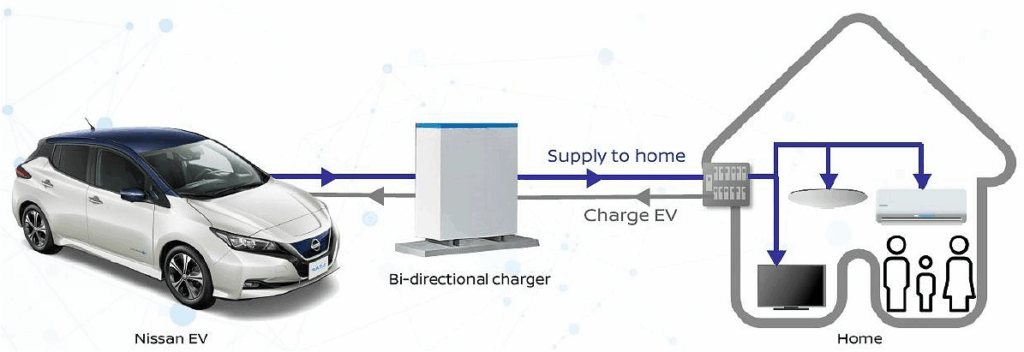
I had a few criteria:
- No Chinese solutions (they tend to send privacy-sensitive data, sometimes even passwords, to a host in China)
- Prioritise charging from our solar panels rather than from the grid
- Software intelligent enough to determine when charging is most affordable
- Act as a (limited) source of 230V power in case of a power outage on the grid.
first, some questionable data practices
Now, before you go off at me in the comments section stating that I’m paranoid and there’s nothing wrong with products from China and they’re all good guys and very ethical and mostly harmless, and anyway you have nothing to hide so who cares where you get your groceries… hear me out on this.
Or rather, hear out what a network handware engineer found out when he got curious about how his Chinese smart robot vancuum cleaner worked.
This is a long and fairly technical read, so let me summarise it for you:
It sent detailed log information, his WiFi password (unencrypted!), and a detailed 3D map of his home, including coordinates, to a remote server in China.
You don’t need a degree in computer science to think of at least one scenario in which this information, in the wrong hands, is potentially dangerous.
And when our engineer blocked outgoing traffic to that host on his router, while keeping over-the-air updates open, the device was intentionally killed by a remote command coming from China. Bricked, kaput, useless, a doorstop.
So… go ahead, call me paranoid alright. You may say I’m not very brave, but you’d be amazed to find out how smart I am. 😎
But I digress (I know… I’m good at that).
I spoke to a couple suppliers, read a load of reviews and white papers. What I learnt:
We would need a home charger that supports the V2X (Vehicle to Anything) protocol, and a car that supports the V2X protocol as well. V2X is the ability to have the car deliver power to the home (V2H, or Vehicle To Home) as well as to the grid (V2G, or Vehicle To Grid). In fact, V2X is many more things, but this summarises its power delivery options.
There are currently, I think, three cars available now that support it (the Kia EV6 I believe), or will support it somewhere this year (the Renault 5 and Renault 4). I am being told that there is also a BYD vehicle that supports this, but the website just specifies V2L, or Vehicle To Load, which means that you can hook up a device with one 230V mains plug. Or an extension cord. But it won’t power your home like a home battery would.
Plus it is Chinese, so there’s more than an outside chance that it’s a data vacuum.
There are also home charger solutions that will support it “in the future”. But when you ask the suppliers when that future might begin, the answer is “… soon”.
… yeah, that’s not helping.
So, we gave up on that idea. Plan B was to get us a plugin hybrid with enough electric range to cover for 80% of our trips, and spend the cost difference on a home battery solution.
So, Plan B, section I is now parked in front of our house.
Plan B, section I – La voîture
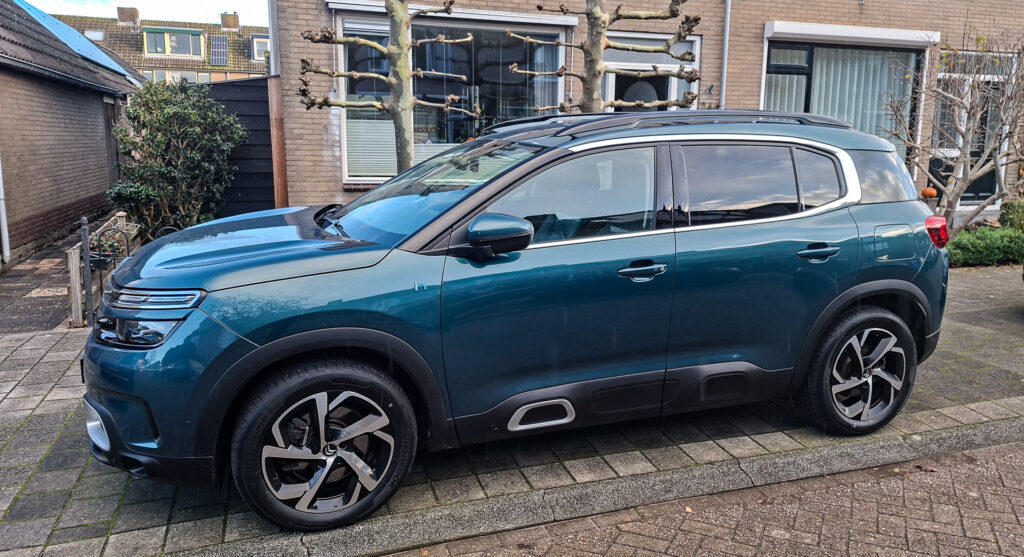
The original idea was a Renault Captur plug-in hybrid. But after reading up on this, we decided not to take that route. We went to visit a supplier in Alphen aan den Rijn (AutoXL), who had a large supply of young secondhand cars, and we were particularly interested in the C5 Aircross and the Mitsubishi Eclipse PHEV.
My beloved found the Eclipse, being the biggest of the two, a bit… intimidating. It’s indeed a pretty sporty looking affair. When we were introduced to the Aircross, it was the colour, but also the somewhat less intimidating (slightly oddball, rounded, somewhat teddy bear-like even) styling that seemed to please her.
It looks big, but in reality it is just a bit (about 7 cm) shorter than the Octavia. Unsurprisingly, it doesn’t have the cargo space of the Octavia, but the Octavia is secretly a Tardis. so there’s that.
So we took that one for a test drive.
I have to say that it has a decidedly non-sporty character — like befits a Citroën, actually. And we both like that. It’s very friendly, a bit forgiving even. It has muscles (229 horsepower combined), but it’s not eager to show them. Suspension is nowhere near the hydropneumatics that made Citroën famous, but it’s still soft, in a controlled way. Progressive hydraulic cushions or something like that. Steering doesn’t give much information about how the tires and the road interact, but it’s comfortably light. It’s a very nice car to relaxedly wallow about in.
I admit that I do sometimes think about how my CX, as well as our XM, were light years ahead of this in terms of creature comfort as well as aesthetics, but unfortunately they don’t make ’em like that anymore.
After driving it, my wife didn’t even want to research other options anymore. Convinced by the one-year full warranty, we decided there and then to get it. I got us a charging solution that plugs into the 230V AC mains in the garage, and if we park it next to the garage door (that’s our property), we can charge it from empty to full overnight.
As I write this, I’ve just updated the car’s firmware. Citroën and their dealer network will tell you this is very complicated, and you might even brick your car. I downloaded the updates and instructions from their web site… and frankly, updating the software or the maps on a Skoda (or any other car from the Volkswagen-Audi Gruppe) is a *lot* more complicated. Just follow the instructions, and lo and behold, it works.
Next: updating the maps. That was a piece of cake too.
The next challenge will be to get the MyCitroën app to work, as it has a few features that we appreciate. This seems… considerably more complicated, so more about that in our December instalment.
Plan B, Section II: the home battery
For home batteries, I had roughly the same criteria:
- No tie-in with an energy supplier
- No Chinese solutions (see my rant in the sidebar “Some questionable data practices” hereabove)
- Prioritise charging from our solar panels rather than from the grid
- Software intelligent enough to determine when charging is most affordable
- Enough capacity to cover our need during peak hours
- Act as a (limited) source of 230V power in case of a power outage on the grid.
Energy supplier tie-in
There is at least one supplier of home batteries that ties you into getting an energy contract from them as well. The downside of it is that, when you want to switch energy suppliers, you can’t use their product anymore. So you’re actually tied in with them for the life of the installation (on average 15 to 25 years). I dread to think what will happen if, at some point, they go tits-up, or (more likely) are acquired by a bigger party.
They actually use the combined batteries of their customers to trade on the energy market themselves. While their current rates are nice, they earn money on this, and they’re not very transparent about that.
But my main concern would be that you’re bound to them for your energy contract as well.
So, what options do we have?
Too many to list, actually. I’m not going through all of the ones I looked into, that would be boring, and there are many I didn’t look intop. But I picked a few that got favourable comments and put them in a shortlist.
From a couple of independent sources without a stake in the matter (an association of home owners and one or two independent consultants), I learnt that, unless you want to go off-grid altogether and have an insane amount of solar panels, it makes no sense whatsoever to buy a solution that has substantially more capacity than you need. If you have household-level solar panel-capacity, you could charge it completely in the summer, but you’ll never manage to do that when the dark months are upon us.
The only reason why you’d want to get more capacity than you need is when you would want to trade energy on the disbalance market. This was quite profitable in 2022, but profits are already collapsing.
What you want is, from, say, April to October, to be able to charge them from your solar panels so you can consume from your battery when it’s dark, plus the next morning, without having po purchase off the grid. Then, in the winter, when your PV installation is struggling to piss out a few watts at all, you will want to charge it during off-peak hours during daytime (between 10am and 4pm) and in the night (from 10pm to, say, 6am the next morning).
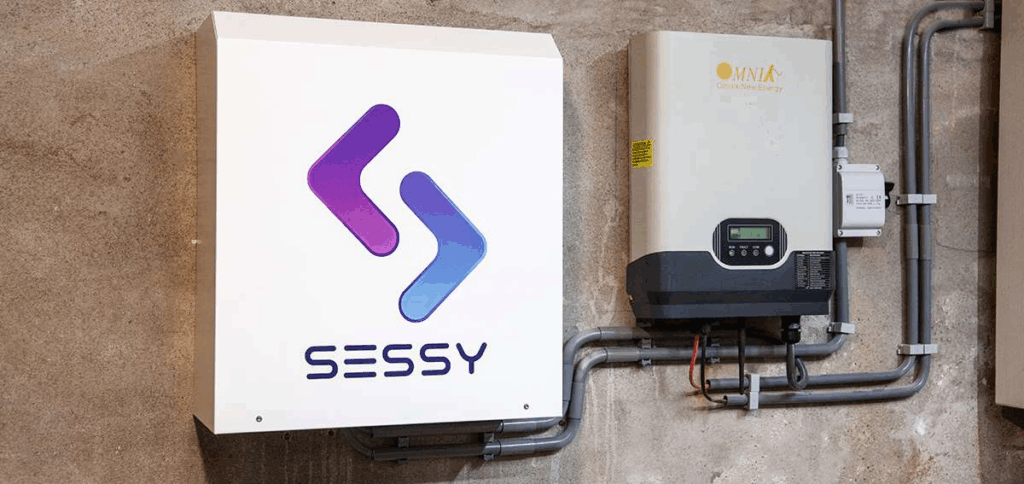
Then, from my shortlist, I ran into Sessy, a Dutch supplier, who actually said “don’t buy too much capacity — we would be the only one profiting from that”.
Wow, I thought, that’s a novel approach. So after reading up on them, and seeing that our current energy supplier has a cashback action for their product, I gave them a ring.
Turns out that they make (not assemble, but design and build) their own batteries, and they create their own firmware and software. Good, that checks off one concern. It also means that their solution is not tied to a specific energy supplier, so there goes another checkbox.
They also have an API, which means I can query, or tailor, the system’s operation to suit my needs.
They confirmed that getting more capacity than we need is pretty useless. On going through my consumption figures, it turned out we have more than enough capacity if we decide to use the 5kWh model, and after determining that their product ticked all the boxes I had defined and getting a quotation, we put in our order. It will be installed on December 23, which leaves us a couple months to decide whether our next contract will be a dynamic contract or a fixed one.
In other news, my two mini-panthers seem to have developed a new understanding.
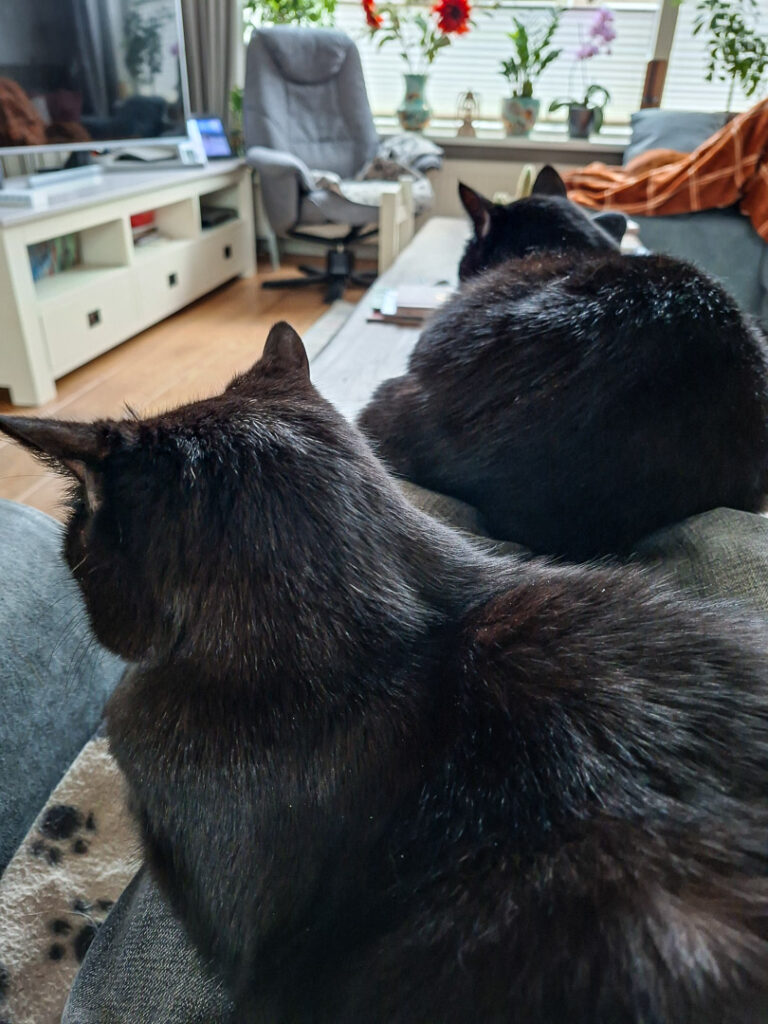
Before this month, this only happened once, in December 2019, after a return of a hospital visit of one week. But these last two weeks, it’s getting more and more common. My lap is under there somewhere!
Oh, wait… I forgot one thing. There was, of course, going to be an item on Adobe Customer Support…

… but I carried that over to a separate blog post.
Expected next month: turning 68, MyCitroën app woes, and the home battery installation.
Jarek 2025-11-30
Peter, I’m totally with you on being cautious with Chinese hardware.
And yes, cats are amazing!
BTW: yesterday we saw this doc about cats in Istambul, highly recommended 🙂
https://www.youtube.com/watch?v=h6EtKnc1mQ4
Annemiek 2025-12-01
Oh yes but “I don’t have any secrets, I don’t care if they steal my data.”
…
…
…
Can’t tell you how many times I’ve heard that.
admin 2025-12-01 — Post Author
Let’s see if they still say that when I post their exact location and their WiFi password on the dark web.
If you don’t have secrets, you do not have a bank account.