
First and foremost: I hope you will have a magnificent, healthy, trouble-free, fruitful and generally happy 2026!
For us, December was another month of no bucket-kicking in our circle of family and friends! Oh, how fondly I remember the time that this wasn’t even worth mentioning…
December was, for us, the month that we got to know our new Citroën C5 Aircross PHEV a bit better.
Mind you, it’s a PHEV (Plugin Hybrid Electric Vehicle), somewhat like the well-known Prius, but with one difference: you can drive it for anything between 30 (in winter) up to 50 kilometers on electric power only. Since most of our trips are shorter than that, for us, that means we save a cartload on gas.
Before we got it, it hadn’t been driven for some time. This means that the Euro 95 fuel had been in there for some time as well.
First thing to know about Euro 95: it contains up to 10% of ethanol, which is considered a renewable resource. This is not a problem when you drive your vehicle regularly. But leave it alone for half a year, and you’ll find that the ethanol, which is very hygroscopic (it loves water) has sucked up some atmospheric water vapour, which is now in your fuel.
Our Citroën noticed it hadn’t been filled with fresh fuel for awhile, and it decided that it would be a good idea to use up that fuel as quickly as possible. As a result, it didn’t want to go in “electric only” driving mode (it actually said “your fuel is too old” on the display).
So, when we had all but emptied the tank, I filled it with premium grade fuel (which contains no ethanol), and lo and behold, filling it up unlocked the electric driving mode level. 😁
Since then, we made one longer trip (220km), and despite that, our average fuel consumption as of December 30 is… let me see… 2.8l/100km (that’s 84 mpg if you’re metrically challenged).
I just did some intermediate Excelling, and it turns out that, if I exclude this long trip, our average consumption worked out to 0.83 liter per 100km, which is a little over 283mpg. Which is mainly because most of our trips are within the electric range even in winter.
Of course, we pay to get the thing charged, so that adds about 8 cents per kilometer to the cost of driving. In winter. With a fixed contract.
But when we change to a contract with dynamic pricing (see the section in the home battery section further down for an explanation), and when the sun is capable of pouring substantial quantities of watts into our solar panels, we’re going to laugh all the way to the bank, as they say in the trade.
In November I mumbled that getting the MyCitroën app to work might be an interesting endeavour.
Turns out there was only one thing wrong: the previous driver had failed to remove the car from his app. After a phone call with the Citroën service desk, this was fixed, and lo and behold, all of a sudden it started to work.
Another issue I had is that I wasn’t able to get the app to turn on the pre-heating feature. This turns out to be caused by the fact that the spot behind our garage, where we charge the car, is a bit of a “3G desert area” – it has no reception on the 3G network that the car uses to communicate with. If I turn the car around (which makes a marked difference), that works too. So now, I can de-ice the car (and warm up the interior) by switching that on 20 mins prior to departure.
So all is good there. Early one morning a few days ago, I finally looked up the correct setting for “regenerative braking” – meaning that, if you step off the accelerator, it’s mimicking the “engine brake” behaviour of an ICE* vehicle. This regenerative braking is quite effective – you can essentially accelerate and decelerate without touching the brake pedal, and the energy generated by deceleration is fed back into the battery.
You’ll still need the brake pedal to get the car to a full stop. And for emergency stops, of course. 😉
Enough about the car for the time being. .
*) If you’re in the USA: in the pre-Trump-II era, ICE meant Internal Combustion Engine.
More good stuff happened! I usually do not indulge in personal affairs in this series, but I’m making one exception this time.
Our oldest grandson wanted to introduce his girlfriend to us.
Yes, you heard me right. His girlfriend.
To his grandparents.
I haven’t asked, but I wonder to this day what she must have thought when she first heard that. Poor creature… she must’ve had visions about flower wallpapers, rocking chairs, ticking clocks, and old cathode ray tube TV, pinewood furniture from a seventies mail order catalog, I don’t know.
But it worked out well. There’s a nice flatscreen TV, our table is a massive undecorated solid oak affair, we have no wallpaper, we had stopped the clock, and the rocking chair is now on the second floor. And she seemed to have a good time, so there’s that.
Next morning, our grandson’s mother spoke to her mother (which is my wife), and I was informed that we got glowing reviews.
Which is nice, because I think our grandson has hit the jackpot (I know my grandson well enough to know that she hit the jackpot as well). I really hope this is going to work for them!
So when I turned 68 this month, they both came over to visit us, even though she was feeling a bit under the weather. My birthday went by without much ado, luckily. We had some family and friends over, but the festivities were low-key, which suits this introvert just fine.
The home battery situation
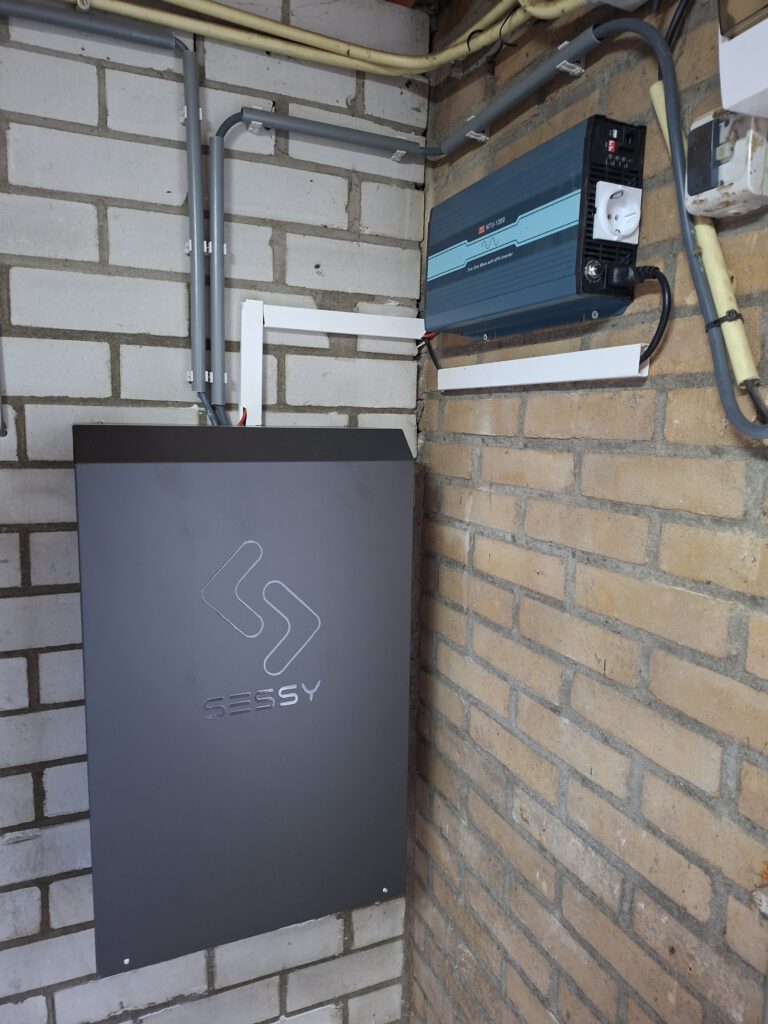
On September 23, we also got our home battery installed.
A bit of background information
If you’re from another country (there are even readers in the US), this requires some explanation, I suppose.
Between, say, 2020 and 2024, the number of homes with solar panels (photovoltaic panels) grew explosively, caused by rising electricity prices, especially after the start of the war in Ukraine. This war, together with the closing down of natural gas extraction from our main gas field in Groningen, drove up gas prices as well, so more and more people turned to electric heating. The government created an arrangement called the salderingsregeling, (netting arrangement), which made sure that, whatever electricity your panels would generate, you could supply back to the grid. So if you’d use, say, 3000 kWh per year, and you bought 2900 kWh, you’d only pay for hundred. And if you’d only use 2800 kWh, then you’d be reimbursed for a hundred.
This had some seriously undesired side effects for the companies maintaining the power grid. Most photovoltaic installations (PV installations) would produce energy when the sun would shine, but most households would only use electric power when they’d be home, which is mainly during the early morning and in the evening. As a result, a substantial part of the electricity produced would be supplied back to the grid.
And then, when we got home and charged our electric cars, cooked our dinners, and did our laundry and stuff, our PV installations would be struggling to piss out a few watts, so we’d be using electricity from the grid, rather than from our own source.
This puts a load on the grid. And now that electric cars become more common, that puts even more load on the grid. As a result, in many locations in the country, the grid is being maxed out. There are many locations that cannot bear to provide additional connections. Upgrading the grid to support heavier use is very costly, and the companies responsible for that are struggling to find the manpower to get that sorted in time.
To at least remedy that situation, the netting arrangement will end by the end of this year, and electricity suppliers came up with dynamic contracts — electricity is cheapest during hours when there is abundant supply, but during peak consumption hours, the price rises steeply. In summer, when solar power peaks, there are days that you will actually get paid if you use electricity — the price (if you have a dynamic contract) is then negative.
A home battery addresses that problem. The idea is to charge the battery when the price is lowest, so that you can use the battery power when prices are highest. During the dark months, the differences aren’t dramatic. For instance, today, between midnicht and 06:00, the price fluctuated between 16 and 18 cents per kWh, but from 7:00 to 23:00 it would be between 22 and 28 cents per kWh.
But in the months where the sun shines more abundantly (longer and more intense), the differentes are bigger. During peak hours (usually in the evening), the price can easily be double the price during cheap hours (usually when the sun is busy pouring power in your solar panels), or even more.
So the spring (from, say, April) and summer (in a good year up to and including September) are where a home battery really starts to make sense.
Back to our situation, then
Initial installation went smooth, but a configuration mishap caused it to happily charge, but not give anything back.
On top of that, three days after it was installed, we had a power outage. Normally, that’s a source of mild irritation, but this time, it presented a nice opportunity to test the backup facility (which supplies limited power when there is a power outage).
Which (you guessed it) failed to work as well.
So, our challenge was to get support in the week between Christmas and New Year’s Eve. And that actually worked. The configuration error was resolved online by the support engineer — and after that was resolved, the backup facility worked as well. Which kind of made sense.
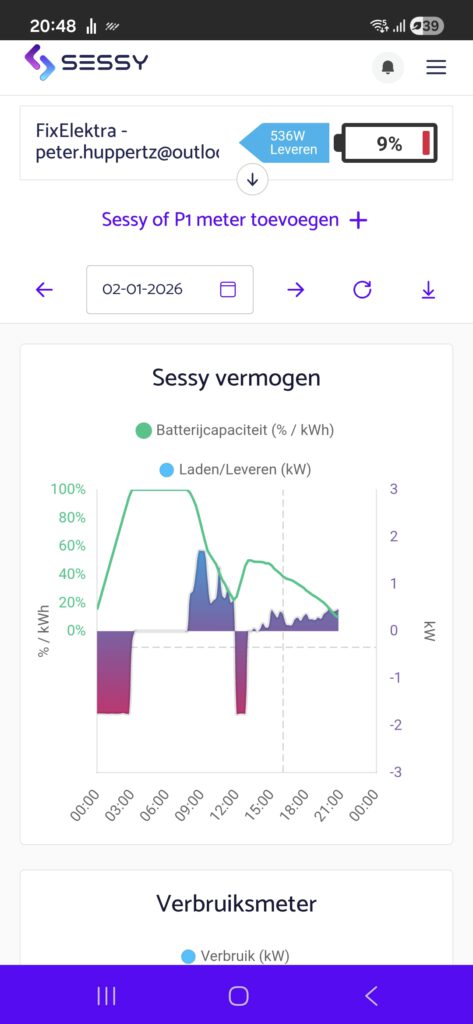
Here you can see it happily chugging along. Charging the batterij to 100% in the cheap hours, then supplying back to our home up to about 12:00, then recharging the battery because the sun came out briefly and it tries to prevent us from supplying back to the grid. And from that point onwards, it supports our electricity usage until about midnight.
We’re now going to see how it works in practice, and if we indeed have sufficient capacity… and then switch over to a dynamic contract in April, so as not only to reduce the load on the net in peak hours (yes, we’re altruistic), but also fully reap profit from it (yes, we like reaping monetary profit from our good deeds as well).
Leave a Reply